


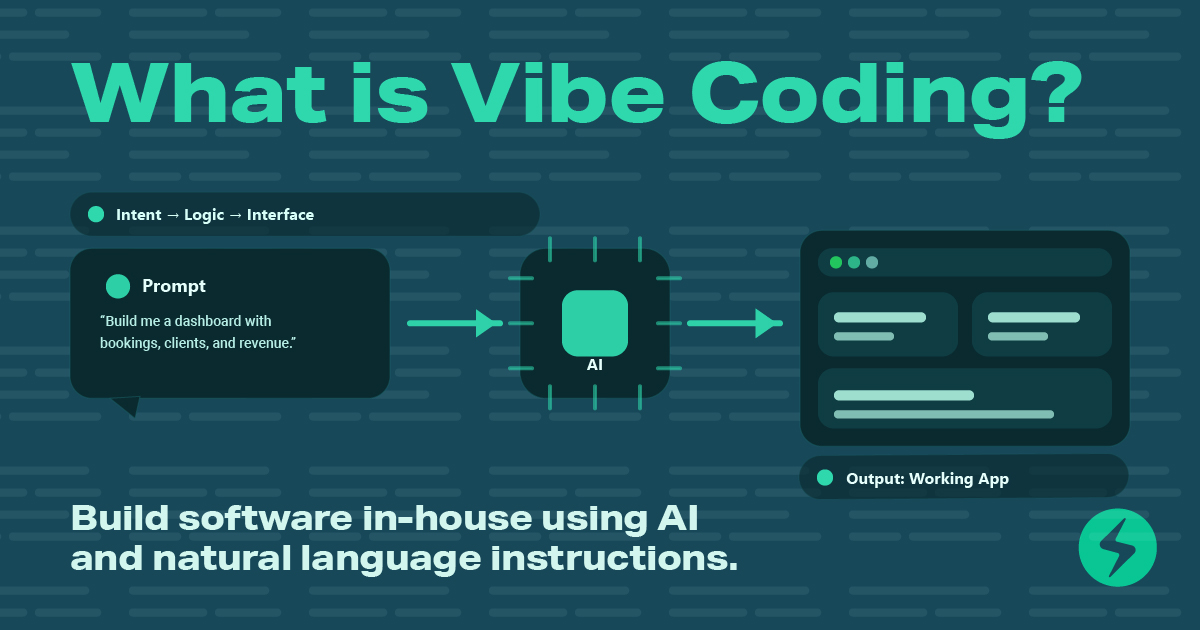
Vibe coding is the modern way of building software without writing most of the code yourself.
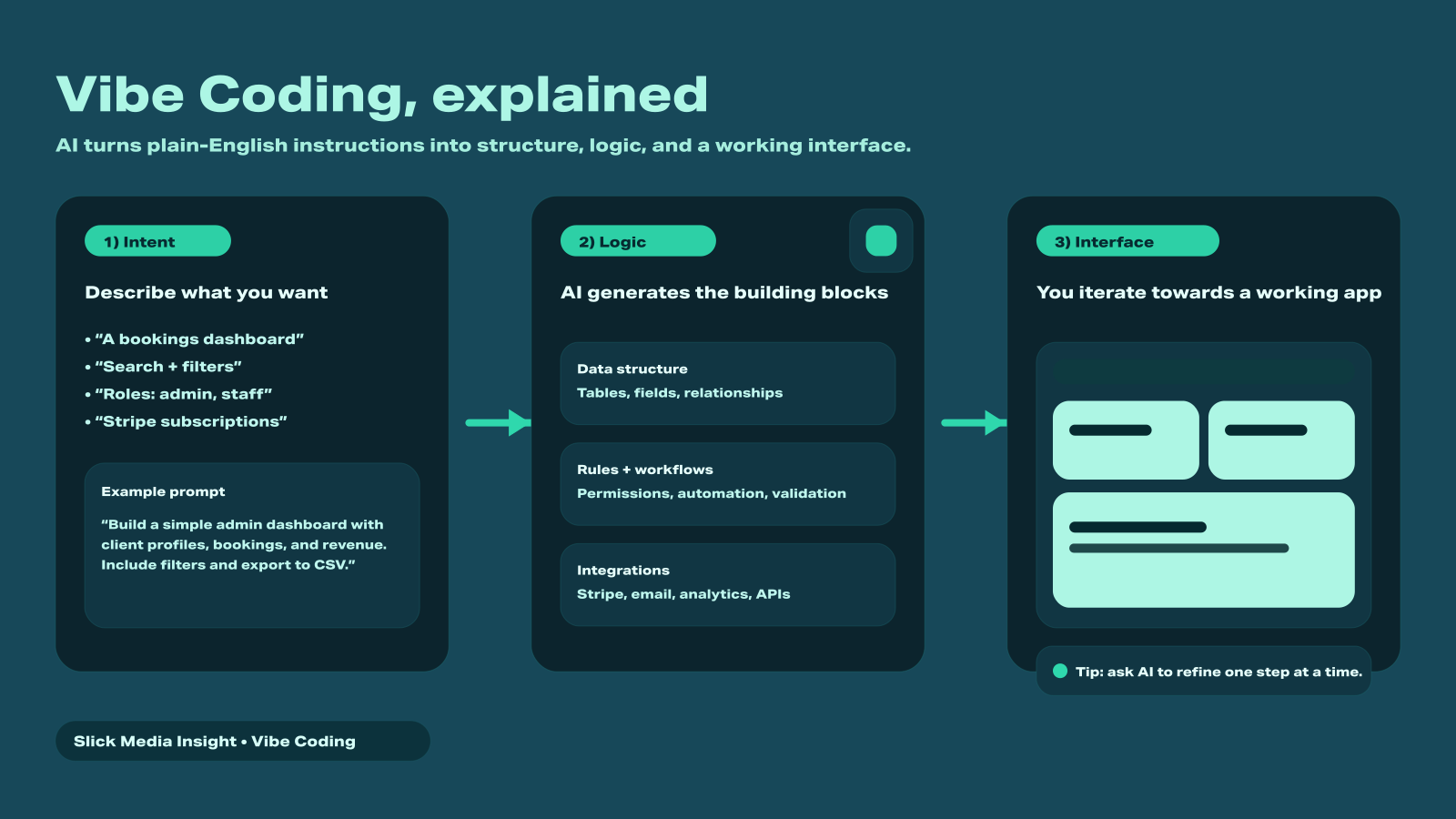
Instead of hiring a development team or learning programming from scratch, you describe what you want in natural language. AI generates the structure, logic and interface. You then refine and iterate.
If you’ve ever searched:
- How do I build a SaaS without a developer?
- How do I create an internal dashboard for my business?
- Can I build software in-house with AI?
- How do I launch an ecommerce app without coding?
You’re already thinking about vibe coding.
It’s not about avoiding technology. It’s about directing it.
What Does Vibe Coding Mean?
Vibe coding is the practice of building applications primarily through AI prompting rather than manual programming.
You focus on:
- What the product should do
- Who it’s for
- How it should feel
- The features it needs
The AI handles:
- Front-end structure
- Basic back-end logic
- Data models
- UI components
- Flow connections
Instead of writing:
“Create a database schema, configure authentication and integrate Stripe.”
You write:
“Build me a SaaS dashboard where users can log in, manage subscriptions and see usage metrics.”
That shift changes everything.
How to Build a SaaS Dashboard Without a Developer
One of the most common searches right now is:
“How do I build a SaaS dashboard in-house?”
Traditionally, you would need:
- A front-end developer
- A back-end developer
- A designer
- Infrastructure setup
- Authentication configuration
- Payment integration
Now, with vibe coding tools, you might start with:
Build me a modern SaaS dashboard with login, subscription billing, account settings and usage tracking. Use a clean, minimal design.
The AI can generate:
- Dashboard layout
- Sidebar navigation
- User authentication flow
- Settings page
- Subscription tier display
- Basic data tracking structure
Then you refine:
- Add role-based permissions
- Add export to CSV
- Add Stripe billing portal
- Add admin view
You’re iterating conversationally instead of architecting manually.
How to Create Internal Business Software In-House
Another high-intent search is:
“How do I build internal software without hiring a developer?”
Imagine you want a client management tool.
The traditional approach is to commission custom development, wait months and spend thousands.
With vibe coding, you might prompt:
Build an internal CRM that lets us log clients, track status, assign team members and export reports.
Then refine:
- Add priority tags
- Add filters and search
- Add activity timeline
- Add email notifications
- Add dashboard analytics
You’re building internal business software without immediately hiring a development team.
How to Launch an Ecommerce Store Without Coding
Common searches include:
- How do I build an ecommerce app from scratch?
- Can I create an online store without coding?
With vibe coding, you could prompt:
Build a clean ecommerce web app selling physical products. Include product pages, user accounts, Stripe checkout and order tracking.
Then expand:
- Add discount codes
- Add subscription products
- Add abandoned cart emails
- Add analytics dashboard
- Add admin inventory management
This allows founders to prototype and validate ideas before committing to traditional development.
Platforms That Enable Vibe Coding
Lovable
Lovable is a strong example of vibe coding in action.
You describe your app idea, and it generates a functional product, often including interface layout, routing and core feature flows.
For example, you might prompt:
Build a modern SaaS dashboard where users can create accounts, manage their subscriptions, and view usage metrics. Include a clean sidebar layout, account settings page, and Stripe billing integration.
Then refine:
- Make the UI more minimal and premium
- Add role-based access (admin and user)
- Add CSV export for usage data
- Add a dark mode toggle
Lovable excels at fast iteration and helping you move from idea to working interface quickly.
Emergent
Emergent leans more towards full-stack generation. It focuses on building functioning systems rather than just interface prototypes.
You might prompt:
Build a web app that lets users register, purchase subscriptions and access gated content. Include an admin dashboard.
Then refine:
- Add reporting
- Add user role permissions
- Add export functionality
- Add audit logs
Emergent feels closer to commissioning a complete system rather than sketching an early idea.
Is Vibe Coding Safe for Real Businesses?
This is where realism matters.
Vibe coding is powerful, but:
- Authentication must be verified.
- Permissions must be tested.
- Data access rules must be checked.
- Scaling must be planned.
AI can generate working systems, but responsibility for quality, security and performance still sits with you.
If you’re building something that handles payments or sensitive data, security should be reviewed carefully before launch.
Can You Really Build Software Without a Developer?
Yes, to a point.
You can build:
- MVPs - Minimum Viable Products are the simplest version of a product that delivers real value to real users.
- Internal business tools
- Early-stage SaaS products - Software as a Service, meaning cloud-based subscription software accessed via a browser.
- Ecommerce validation projects
- Workflow automation tools
But as complexity grows, you will eventually need technical oversight.
Vibe coding reduces the barrier to entry. It doesn’t remove the need for discipline.
Best Practices for Building In-House With AI
If you want to create software without a developer:
- Start small and build the simplest working version.
- Add features one at a time.
- Test every flow manually.
- Lock down authentication early.
- Keep prompts specific and structured.
- Document how your system works.
Clear intent builds better software.
In Summary
Platforms like Lovable and Emergent are accelerating a fundamental shift in how software gets built.
What once required a full development team, long timelines and significant upfront investment can now begin with structured prompting, clear requirements and rapid iteration.
Vibe coding doesn’t eliminate developers, nor should it. Complex systems, high-scale infrastructure and security-critical platforms still require experienced engineering oversight. AI can generate working systems, but responsibility for quality, performance and security still sits with the builder.
What it does change is the starting point. The barrier to entry is lower. Founders, operators and small teams can now build SaaS dashboards, create internal business software, launch ecommerce applications, test product ideas and develop tools in-house without immediately hiring a traditional development team.
The practical shift is that you no longer have to wait to explore an idea. You can build a first version, put it in front of users and see whether it has traction. If it works, you invest properly and scale it with the right technical structure. If it doesn’t, you have learned quickly and with far less risk.
Vibe coding doesn’t replace developers. It simply changes when and how you need them. It makes experimentation more accessible, shortens the gap between idea and execution, and allows more people to begin building before deeper technical expertise becomes necessary.








.png)









Join in the Discussion